



Blog
Modular Kitchen Vs Traditional Kitchen

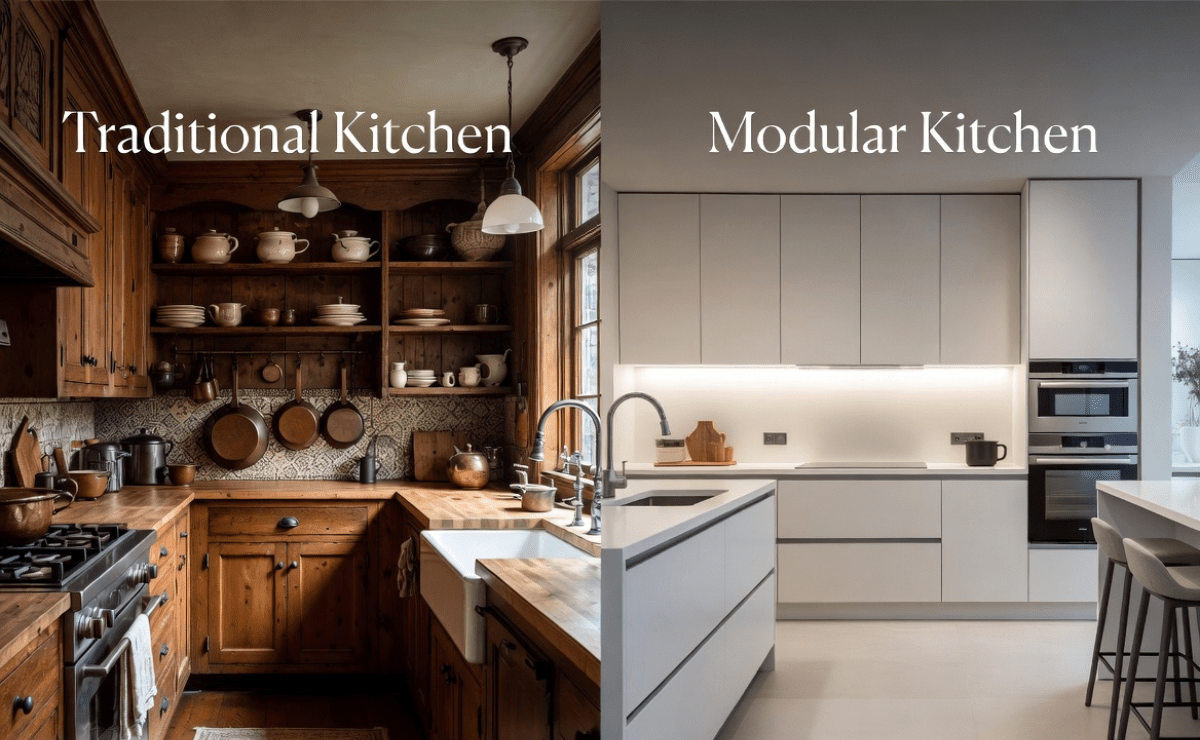
Amodular kitchenand a traditional (carpenter‐made)kitchenboth serve the same purpose, but they differ vastly in design, functionality, and long‐term usability.In today’s compact apartments and modern homes, modular kitchens are increasingly preferred because they offer better space use, durability, and lifestyle‐driven features.
What is a modular kitchen?
Amodular kitchenis built from pre‐designed, factory‐made units such as base cabinets, wall cabinets, tall units, and countertop slabs that fit together like a puzzle.These units are manufactured in a controlled environment and then assembled on‐site.Materials commonly
used include plywood, laminates, acrylic, and quartz tops, chosen for strength, water resistance, and easy maintenance.
Key features of modular kitchens:
- Standardized, interlocking units.
- Precision engineering with minimal material wastage.
- Smooth fittings, soft‐close drawers, pull‐outs, and corner solutions.
What is a traditional kitchen?
Atraditional kitchen(also called a “normal” or carpenter‐made kitchen)is built on‐site by local carpenters using wood or particle board.Every shelf, cabinet, and frame is cut and assembled directly in your home according to the given measurements.
Traditional kitchens depend heavily on the skill of the carpenter and often have:
- Thicker, bulkier cupboards.
- More visible joints and manual finishing.
- Less standardized storage and hardware.
Feature | Modular kitchen | Traditional kitchen |
|---|---|---|
Construction method | Factory‐made units assembled on‐site | Custom‐built on‐site by carpenters |
Space use & storage | Optimized, uses every corner, pull‐outs, | Often wasted space, fewer smart storage |
Time to install | Faster,usually 3–7days | Longer,depends on carpenter’s |
Durability & | More durable surfaces, easy to replace | Prone to warping, harder and costlierto |
Design flexibility | Wide range of styles,colors,and | Limited by carpenter’s skill and material |
Cost structure | Higher upfront but efficient material use. | Lowerinitial cost but can be wasteful |
Why modular kitchen is more useful than traditional kitchen
1. Better space optimization
Modular kitchens are designed to maximize every inch, especially in small apartments.Corner cabinets, pull‐outs, and tall units eliminate wasted space and keep countertops clear for cooking.Traditional kitchens often leave awkward gaps and under‐used corners.
2. More organized and ergonomic layout
The “work triangle” (sink–cooktop–refrigerator) can be planned accurately in modular kitchens, reducing movement and making cooking easier.Pre‐designed layouts such as L‐shaped, U‐shaped, parallel, or island kitchens fit your exact room size and lifestyle.
3. Higher durability and easy maintenance
Because modular units are factory‐made, materials are treated for moisture, termites, and wear. Many systems use moisture‐resistant boards and laminates that last longer than regular wood. If a door or drawer gets damaged, you can replace just that unit instead of redoing the whole cabinet, which is usually required in traditional kitchens.
4. Modern functions and aesthetics
Modular kitchens support modern features like:
- Built‐in appliances (oven, microwave, dishwasher).
- Integrated lighting and pull‐out racks.
- Sleek, handle‐less designs and designer finishes.
These make the kitchen look modern and feel more like a lifestyle space, not just a cooking area.
5. Easier to upgrade or modify
If your family size or lifestyle changes, modular kitchens can be reconfigured—adding a new unit, changing a drawer, or updating the countertop—without tearing down the whole structure.Traditional kitchens are rigid;changes usually mean fresh carpentry and higher
disruption.
6. Long‐term value and resale appeal
Awell‐designed modular kitchen adds perceived value to your home and is attractive to buyers if you ever sell or rent.Buyers today expect clean, organized, and functional kitchens, which modular designs provide more consistently than traditional setups.
When a traditional kitchen might still make sense
Atraditional kitchencan be suitable if:
- You have a very irregular or old house with uneven walls.
- You strongly prefer natural wood with a rustic, handmade look.
- Your budget is tight and you do not plan to live in the home for many years.
However, for most modern homes and apartments in Bangladesh in 2026, a modular kitchenis the smarter, more useful choice because it saves space, improves workflow, and ages better over time.